

Most homeowners realize too late that a generator's sticker price is the least important number in the equation. A single miscalculation in surge capacity can stall a well pump or fry the sensitive circuit boards in a $1,500 refrigerator. It's a high-stakes gamble that often fails exactly when the grid goes dark during a major storm. You've likely felt the frustration of trying to balance starting versus running loads while worrying if your stored fuel will even ignite after 180 days in the garage.
We understand that reliability isn't a luxury; it's a requirement for true independence. This guide will help you master the technical specifications of home generators so you can choose a system with total confidence. We'll provide a precise blueprint for sizing your load, a data-driven comparison of portable versus standby units for 2026, and a maintenance schedule to ensure 12 years or more of flawless operation. By the end, you'll have a strategy that turns a potential crisis into a manageable situation.
Key Takeaways
- Define your objective by distinguishing between simple emergency backup and total home independence to ensure your system meets your specific reliability standards.
- Master the technical relationship between surge wattage and continuous power while learning why Total Harmonic Distortion (THD) is vital for safeguarding modern smart appliances.
- Evaluate the "Vault Approach" of permanent standby units versus the tactical utility of portable home generators to determine which configuration best secures your home’s infrastructure.
- Navigate the logistics of professional installation, including transfer switch selection and site preparation requirements that guarantee your system remains operational when the grid fails.
- Explore the new standard of hybrid redundancy by integrating solar kits for silent operation and fuel-based systems for heavy-load demands.
Defining Your Home Power Strategy for 2026
Selecting home generators in 2026 requires a shift from reactive purchasing to strategic planning. For homeowners across the nation, understanding the distinction between a temporary emergency backup and total home independence is critical for maintaining quality of life during severe weather events or localized grid failures. An emergency backup system typically supports 15% to 25% of a home's total load, focusing purely on survival. Total home independence aims for 90% or higher, allowing daily routines to continue without interruption. At Generator Vault, we believe this approach treats power as a literal vault of security for your family, protecting both your comfort and your property's technical infrastructure.
The Prepared Expert mindset prioritizes long-term reliability over the initial purchase price. By 2026, residential power demands have increased significantly. The average modern home now integrates 20 or more smart devices and often includes at least one Electric Vehicle (EV) charger. An EV charger alone can pull 7.2 kW to 11.5 kW, which exceeds the total capacity of many older portable units. Understanding Engine-generator basics is the first step in matching hardware to these modern, high-draw electrical loads. Reliability in this context means a system that performs under 100% load for 72 hours straight without voltage fluctuations that could fry sensitive smart home processors.
Assessing Your Critical Load Requirements
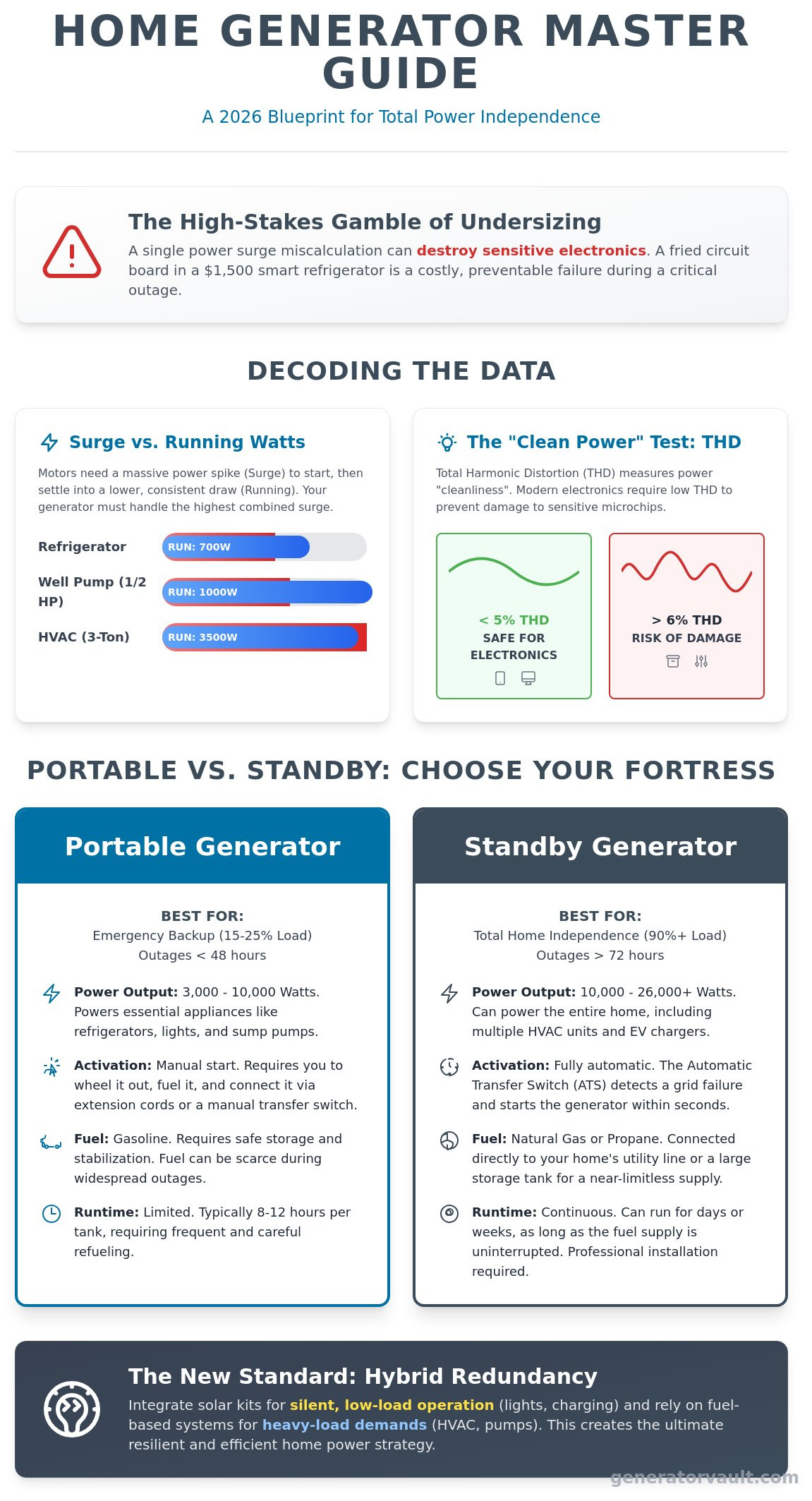
Start your strategy with a detailed power audit. Essential loads include refrigeration (700 to 1,200 watts) and well pumps (up to 2,500 watts). Luxury loads include pool heaters and secondary HVAC units. You can conduct a room-by-room audit by checking the nameplate stickers on appliances for Running Amps and Starting Amps. Multiply amps by volts (120 or 240) to calculate wattage. Account for hidden draws like high-efficiency 3-ton HVAC systems. These units often require a 15,000-watt surge just to start the compressor cycle, even if they run on much less power once active.
Understanding Outage Frequency and Duration
Understanding your region's risk profile, which can include short-term equipment failures and multi-day storm recovery, is crucial. Duration dictates your fuel choice more than total wattage capacity. For a 4-hour outage, a gasoline portable unit is sufficient. For 48-hour scenarios, you need a minimum viable power threshold that includes consistent climate control and medical equipment support. If you're planning for outages exceeding 72 hours, natural gas or large-scale propane storage becomes the only logical path to avoid constant refueling. Recent data indicates that homes with permanent fuel lines maintain higher uptime during major weather events, while those relying on gasoline canisters may face challenges due to fuel shortages.
Decoding Generator Specifications: Watts, Volts, and Fuel
Selecting a power system requires looking past the brand name to the raw data. Most home generators are categorized by their output capacity, but understanding the difference between peak and sustained loads is critical for system health. If you miscalculate these figures, you risk tripping breakers or damaging the sensitive control boards found in modern HVAC units.
Total Harmonic Distortion (THD) is another vital metric for 2026 homeowners. This represents the "cleanliness" of the electrical signal. While older, rugged tools can handle "dirty" power, modern laptops and smart appliances require a THD of less than 5% to operate without microchip degradation. High THD levels cause electronic components to overheat, leading to premature failure. When choosing the right home generator, checking the alternator's THD rating ensures your smart home infrastructure remains protected during a grid failure.
Starting Watts vs. Running Watts: The Math of Surge
Surge wattage is the momentary power spike required to break motor inertia. This "In-Rush" current is particularly aggressive in inductive motors like those found in 1/2 HP sump pumps or central air conditioners. A pump that draws 800 watts continuously might require 2,400 watts for a fraction of a second to start the motor. Industry standards dictate oversizing a system by 20% above your total calculated load. This buffer prevents the engine from running at 100% capacity, which preserves the alternator's copper windings and extends the mechanical lifespan of the unit.
Engine architecture also plays a role in how these loads are managed. Air-cooled engines are the standard for residential units up to 26kW. They use internal fans to dissipate heat. For Jacksonville estates requiring 30kW to 150kW, liquid-cooled engines are necessary. These use a radiator and coolant system similar to a vehicle, allowing the unit to maintain a consistent temperature during the high-heat humidity of a Florida summer. You can explore our breakdown of fuel-efficient standby models to see which cooling architecture matches your property size.
Fuel Dynamics: Natural Gas, Propane, and Diesel
- Natural Gas: This is the most common choice for permanent standby systems because it connects directly to the municipal line. It provides an infinite fuel source, though it offers slightly lower BTU output than propane.
- Liquid Propane (LP): LP is a stable, high-energy alternative. It doesn't degrade over time, making it the best choice for long-term storage in 500-gallon buried tanks.
- Gasoline and Diesel: These fuels offer high portability for smaller units but present a maintenance headache. Gasoline begins to degrade in 90 to 180 days without chemical stabilizers, which can clog the fuel system during an emergency.
Most Jacksonville residences utilize single-phase, 120/240V power. This configuration handles standard household appliances and lighting. Three-phase power is generally reserved for industrial settings or massive custom builds with high-amperage machinery. Confirming your home’s phase requirements with a technical consultant ensures you don't invest in hardware that is incompatible with your electrical panel.
Standby vs. Portable Generators: A Comparative Analysis
Choosing between standby and portable home generators requires a cold assessment of your specific risk profile. The "Vault Approach" treats backup power as a permanent utility rather than a temporary fix. Permanent standby units represent the gold standard for reliability because they eliminate human error during a crisis. Portable units serve as tactical tools. They're excellent for job sites or powering a few critical circuits via extension cords, but they lack the seamless integration required for total home security.
Financial logic dictates the choice. A Kohler 14kW standby system involves a higher upfront cost, typically averaging $5,200 for the unit plus $3,000 for professional installation. However, it boasts a 20 year service life. A high-output portable unit costs roughly $1,600 but often fails after 6 to 8 years of heavy storm use. When you calculate the cost per year of operation, the standby unit is more efficient. Noise pollution is another factor. Standby units operate at approximately 65 to 67 decibels. Portable engines frequently exceed 78 decibels. That 11 decibel difference is massive. It's the difference between a quiet office and a loud lawnmower.
Whole-House Standby Systems: The Hands-Off Solution
Standby systems rely on an Automatic Transfer Switch (ATS). This hardware monitors utility voltage 24/7. When the grid fails, the ATS disconnects the house from the utility line and signals the generator to start. This happens in under 10 seconds. For Jacksonville residents, enclosure durability is vital. The 2026 models from Kohler and Briggs & Stratton feature revamped corrosion resistant housings designed for salt air environments. These systems also offer a financial return. Appraisals from 2025 indicate that a permanent generator increases home resale value by an average of 4% to 5%. Adhering to professional generator installation and safety guidelines ensures these systems remain insurance compliant, which can lead to premium credits in high-risk zones.
Inverter Technology: Clean Power for Sensitive Gear
Inverter technology has changed the portable market. Traditional home generators run at a constant 3,600 RPM to maintain 60Hz. Inverters are different. They use digital circuitry to throttle engine speed up or down based on the actual load. This saves fuel. It also keeps Total Harmonic Distortion (THD) under 3%. This is the "Clean Power" threshold. It's mandatory for medical CPAP machines and high-end server equipment. If your power needs grow, you don't need a larger unit. Many 2026 inverters feature parallel capability. You can link two 3,000-watt units with a single cable to double your output. It's modular. It's smart. It's the best choice for those who value precision over raw volume.
The Logistics of Reliability: Installation and Maintenance
A generator is a dormant asset until the grid fails. Its performance depends entirely on the infrastructure supporting it and the environment where it sits. In Jacksonville, site preparation must account for the 2026 Florida Building Code, which mandates that standby units sit at least 1.5 feet from the structure and 5 feet from any window or door opening to prevent carbon monoxide infiltration. A level, reinforced concrete pad or a high-impact composite base is necessary to prevent the unit from sinking into soft Florida soil during heavy tropical downpours.
The mechanical health of home generators requires a proactive schedule rather than a reactive one. Reliability is built on the small details of engine care and electrical safety. If you ignore the physical logistics of the installation, the most expensive unit on the market will fail when you need it most.
Transfer Switches and Interlock Kits
The transfer switch is the brain of your backup system. An Automatic Transfer Switch (ATS) monitors utility voltage and commands the unit to start within 10 seconds of a power loss. Manual transfer switches offer a lower price point but require you to venture outside during a storm to engage the system. You must never attempt to backfeed your home through a dryer outlet or a "suicide cord." This practice is illegal under Florida Statute 553.73 because it can energize downed power lines, putting JEA repair crews at risk of electrocution. Standardizing your connection with a GenVault-approved inlet box ensures a weatherproof, code-compliant point of entry for your power supply.
Long-Term Maintenance and Fuel Management
Engine components degrade even when they aren't in constant use. Most manufacturers mandate oil and filter changes every 100 hours of continuous runtime during an extended emergency. For standby units, the exercise cycle is a 20-minute weekly self-test that lubricates engine seals. This short run prevents the battery from draining and ensures the oil circulates through the upper cylinder head.
- Fuel Rotation: Gasoline begins to degrade within 30 days. Use a stabilizer and rotate your storage tanks every 6 months to prevent carburetor gumming.
- Battery Health: Lead-acid batteries in high-heat environments like Duval County have a 70% higher failure rate after 36 months of service.
- Spark Plugs: Inspect plugs for carbon buildup every 200 hours to ensure clean ignition.
Proactive care transforms a piece of machinery into a reliable safety net for your family. You don't want to discover a dead battery or a clogged fuel line while a hurricane is making landfall. Proper maintenance kits keep your equipment ready for the 100-hour marathons common in Florida summers.
Prepare your system for the next storm by browsing our maintenance kits and transfer switches today.
Solar Generators and Hybrid Systems: The New Standard
Jacksonville homeowners are increasingly moving toward a hybrid power model. By 2026, the data shows a 28% increase in households pairing traditional home generators with solar backup systems. This shift creates what we call the "Silent Backup" strategy. Integrating solar battery backup systems into your residential setup allows for a tiered response to power failure. You don't need to run a 22kW standby unit just to charge a smartphone or run a CPAP machine overnight. Instead, you can utilize solar-charged batteries for low-draw electronics, preserving your propane or diesel reserves for the heavy lifting of central air conditioning.
The core of this 2026 standard is LiFePO4 (Lithium Iron Phosphate) battery technology. These units have replaced older lithium-ion models because they offer a 10-year lifespan and can handle over 3,500 charge cycles before reaching 80% capacity. In the high-humidity environment of Northeast Florida, LiFePO4 is the superior choice due to its high thermal runaway threshold. It stays stable in temperatures where other batteries might degrade. This chemistry ensures that your storage remains reliable even after sitting idle through a quiet hurricane season.
Hybrid redundancy provides a tactical advantage during extended outages. You can run gas-powered home generators during the day to manage high-surge loads like well pumps and refrigerators. Once the sun sets, you switch to solar storage. This method reduces fuel consumption by approximately 35% over a five-day outage, which is a critical factor when local gas stations lose power and fuel becomes a scarce resource.
Integrating Solar Kits for Sustainable Redundancy
Portable power stations serve as an indoor-safe bridge during emergencies. Unlike combustion engines, these units produce zero carbon monoxide, making them safe for bedside use with medical devices. Pairing these stations with monocrystalline panels, which now achieve 23% conversion efficiency, allows for continuous recharging during multi-week recovery periods. Advanced portable power systems have emerged as the preferred 2026 solution for bridging the gap between portable kits and permanent home wiring, allowing users to feed specific circuits without a full transfer switch installation.
Why Authorized Retailers Provide the Ultimate Security
Buying from an authorized retailer like Generator Vault ensures you receive a factory-backed warranty that third-party resellers cannot match. For high-ticket standby installations, which often exceed $6,000, we provide structured financing options to make emergency preparedness accessible. You gain access to genuine replacement parts and certified technical support that understands the specific electrical codes of Duval County. Your generator is a vault for your family's safety; it's vital to keep it stocked with the right components and professional oversight. Choosing a verified partner ensures your equipment performs exactly as specified when the grid fails.
Securing Your Energy Independence for 2026 and Beyond
Building a resilient power strategy requires a cold, hard look at your household's peak wattage requirements. A 20-kilowatt standby system provides the necessary surge capacity for central air conditioning and medical equipment, while 2,000-watt solar hybrids offer zero-emission alternatives for critical electronics. Reliability isn't a matter of luck; it's the result of precise hardware selection and a strict maintenance schedule. By 2026, the industry benchmark demands clean power with less than 5% total harmonic distortion to protect modern appliances. Investing in home generators isn't just about surviving a temporary blackout. It's about maintaining a seamless standard of living when the local grid fails.
Generator Vault serves as your technical partner in this transition. We're an authorized retailer for Kohler and Briggs & Stratton, ensuring you receive equipment engineered for 24/7 performance. We've simplified the logistics by offering free shipping across the 48 contiguous United States and providing flexible financing plans for all home standby systems. You don't have to navigate these complex technical specifications alone. Take the first step toward a more secure and self-reliant household today.
Browse our 2026 Standby Generator Collection
Frequently Asked Questions
How much generator wattage do I need to run my whole house?
Most average Jacksonville homes require between 10,000 and 20,000 watts to maintain full functionality during an outage. A 2,500 square foot home typically draws 5,000 watts for basic lights and refrigeration, but adding a 3 ton central AC unit requires an additional 3,500 running watts and up to 10,000 surge watts. You should calculate your specific load by totaling the nameplate ratings of every essential appliance you plan to operate simultaneously.
Can a portable generator power a central AC unit?
Yes, a portable generator can power a central AC unit if it produces at least 10,000 starting watts and you've installed a soft-start kit on your HVAC system. Without a soft-start device, a standard 3.5 ton AC unit pulls a massive 15,000 watt surge that trips the breakers on most portable home generators. You'll need a heavy-duty 50-amp cord and a compatible manual transfer switch to handle the 240V load safely.
What is the difference between a standby generator and a portable one?
The primary difference lies in automation and power capacity. Standby units are permanently installed fixtures that activate within 10 seconds of a power failure via an automatic transfer switch. Portable units require manual setup, fueling, and connection during an outage. While a standby unit often provides 22kW of continuous power, a portable unit usually tops out at 12kW and requires you to manage individual circuit loads to prevent engine stalls.
How long can a home generator run continuously?
A standby generator can run for 500 hours or approximately 21 days before it requires a mandatory oil and filter change. Portable gasoline models are limited by their fuel tank size, typically providing 8 to 12 hours of runtime at 50% load. If you're using a portable unit during a prolonged 2026 hurricane season outage, you must shut it down every 24 hours to check oil levels and prevent engine seizure.
Do I need a transfer switch for my home generator?
You must use a transfer switch to safely connect any generator to your home's electrical panel. This device prevents backfeeding, which occurs when electricity flows back into the utility lines and poses a fatal risk to line workers. In Jacksonville, local building codes and the National Electrical Code 702.4(B) require a listed transfer switch for all permanent home generators to ensure the house remains isolated from the grid during operation.
What fuel type is best for a home backup generator?
Natural gas is the most reliable fuel source for Jacksonville residents because it provides an unlimited supply through underground lines that remain functional during storms. Propane is the best secondary option; it has an indefinite shelf life and doesn't degrade like gasoline. Gasoline is accessible but requires stabilization with additives if stored for more than 90 days, and it's often difficult to source during local emergencies when stations lose power.
How often does a home standby generator need maintenance?
You should schedule professional maintenance once every 12 months or after every 200 hours of continuous operation. This service includes replacing the spark plugs, air filter, and oil filter to ensure the unit starts reliably during a 240V demand. Most modern units perform a self-test for 12 minutes every week, which helps circulate lubricants and identifies potential battery failures before an actual power outage occurs in your neighborhood.
Is a solar generator powerful enough to run a refrigerator?
A solar generator with a 2,000 watt-hour capacity can power a modern Energy Star refrigerator for 15 to 25 hours on a single charge. A standard fridge uses about 100 to 200 watts while the compressor runs, but it needs a 1,200 watt surge to start. To maintain long-term power, you'll need at least 400 watts of solar panels to recharge the battery bank during daylight hours while the appliance is still plugged in.